Redon Entry Points and How Your Home’s Foundation Affects Radon

How Your Home's Foundation Affects Radon
Most people think radon is simply a number on a test report.
In reality, the story begins beneath your home.
The type of foundation you have, what's underneath that foundation, and how air moves through the building all play an important role in how radon enters and accumulates indoors.
Understanding these factors can help explain why one home has low radon levels while a similar house next door may test much higher.

How Your Home's Foundation Affects Radon
Most people think radon is simply a number on a test report. In reality, the story begins beneath your home. The type of foundation you have, what's underneath it, and how air moves through the building all play an important role in how radon enters and accumulates indoors. Understanding these factors can help explain why one home has low radon levels while a similar house next door may test much higher.
The Nature of Radon

Radon is a naturally occurring radioactive gas that forms in soil and rock beneath the earth's surface. Outdoors, radon is diluted by fresh air. Problems occur when it enters a home and becomes trapped indoors, where it can build up over time. Since radon originates in the soil, every home has the potential for radon entry regardless of age, size, price, or location. The important question isn't whether radon exists beneath your home. The important question is how easily it can enter.
Why Even New Homes Can Have Radon Problems
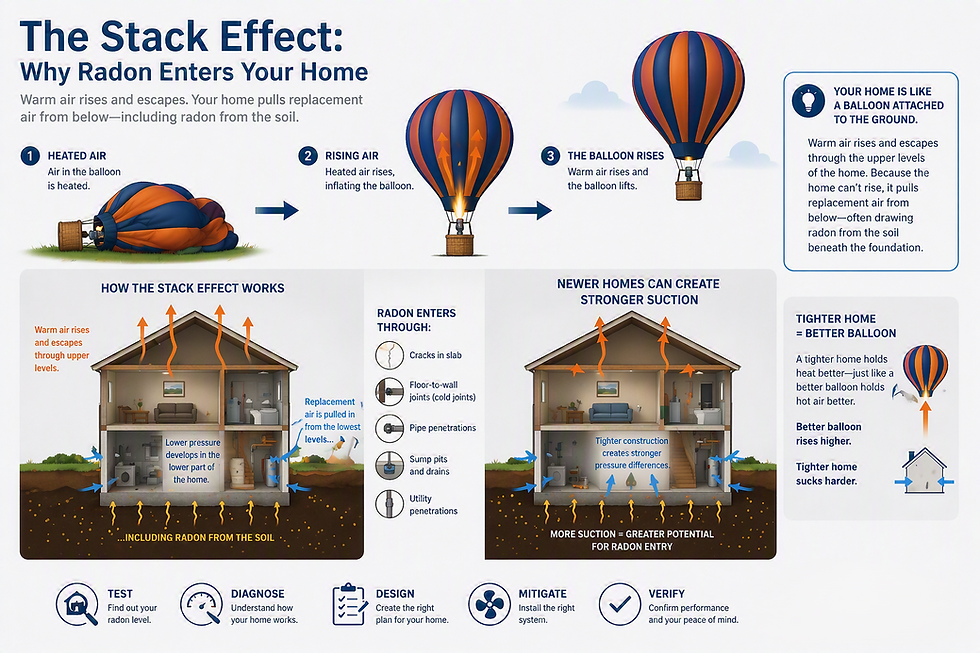
One of the biggest myths is that radon is only found in old homes. Modern homes are built to be more energy efficient, meaning they are tighter. However, tighter homes can create stronger pressure differences, drawing replacement air—and radon—from the soil beneath.
The Vacuum Effect: Like a Hot Air Balloon
As warm air rises (stack effect) and escapes through upper portions, the home creates a slight suction at lower levels. Since the home is attached to the earth, that suction pulls air—including radon-containing gases—from beneath the foundation.
What's Under Your Foundation Matters
Hidden conditions influence radon movement. Clean gravel facilitates drainage but also allows gases to move freely. Clay or bedrock creates different pathways. Hidden materials determine how a mitigation system must be designed.
Common Places Radon Can Enter

One House. Different Rooms. Different Radon Levels.
Many homeowners assume that if one room tests low for radon, the rest of the home must be similar. In reality, radon does not always spread evenly throughout a home.
Airflow patterns, pressure differences, foundation conditions, room layout, HVAC systems, and ventilation can all influence where radon accumulates. As a result, two rooms on the same floor can have very different radon concentrations.
At Radon Hound, we've seen homes where an open basement living area had relatively low radon levels while a nearby bedroom or playroom on the same level measured significantly higher. This is why testing strategy matters.
A single measurement does not always tell the complete story. Understanding how a home is built, how it is used, and where people spend their time can help provide a more accurate picture of radon exposure.
🐾 Hound Fact
Just because one room tests low does not automatically mean every room in the home is low. Radon can vary significantly from room to room within the same house.
Why We Look Beyond a Single Number
Radon Hound goes further: we analyze your home’s layout to ensure complete clarity.
By understanding airflow, pressure relationships, foundation design, and room usage, we can make informed decisions about where to test, how to interpret results, and what solutions may be most appropriate. Because people don't live in averages. They live in rooms. And that's why understanding the house matters. We don't start with the fan. We start by understanding the house. 🐾
Different Foundations, Different Challenges
Basement Foundations
Slab-on-Grade Foundations
Common in Nova Scotia, basements have the largest contact area with soil. Entry points include slabs, sump pits, and wall cracks. Most respond very well to ASD systems.
Living space sits directly above the slab, so radon entering through cracks or joints mixes quickly with indoor air.
Crawlspaces
Mixed Foundations
Exposed soil and damaged barriers contribute to levels. As warm air rises through the home, air from the crawlspace is drawn upward along with it.
Homes with multiple foundation types create distinct pressure zones. Each area may have its own soil conditions and air pathways requiring custom solutions.

Why Your Neighbour's Results May Be Different
Every home is unique. Radon is influenced by soil footprint, foundation design, heating systems, and renovations. Even side-by-side homes built by the same builder can have wildly different readings. That's why testing is critical.
Why Diagnostics Matter
The Radon Hound Approach
We take a diagnostic-first approach using professional monitoring and specialized tools to evaluate how your specific foundation is behaving. Our goal is understanding the house before the solution.
Radon mitigation is about understanding the house before the fan. We evaluate pressure relationships and sub-slab communication to design solutions based on measured info rather than assumptions.
The Bottom Line
Your house behaves like a balloon attached to the ground. As warm air rises and escapes, the house pulls replacement air from below. Sometimes that air brings radon with it. Understanding this is the key to an effective solution.

Need Help Understanding Your Home's Radon Risk?
Whether you have a basement, crawlspace, or mixed foundation, we start by understanding the house. Let Radon Hound provide precise measurement and peace of mind.