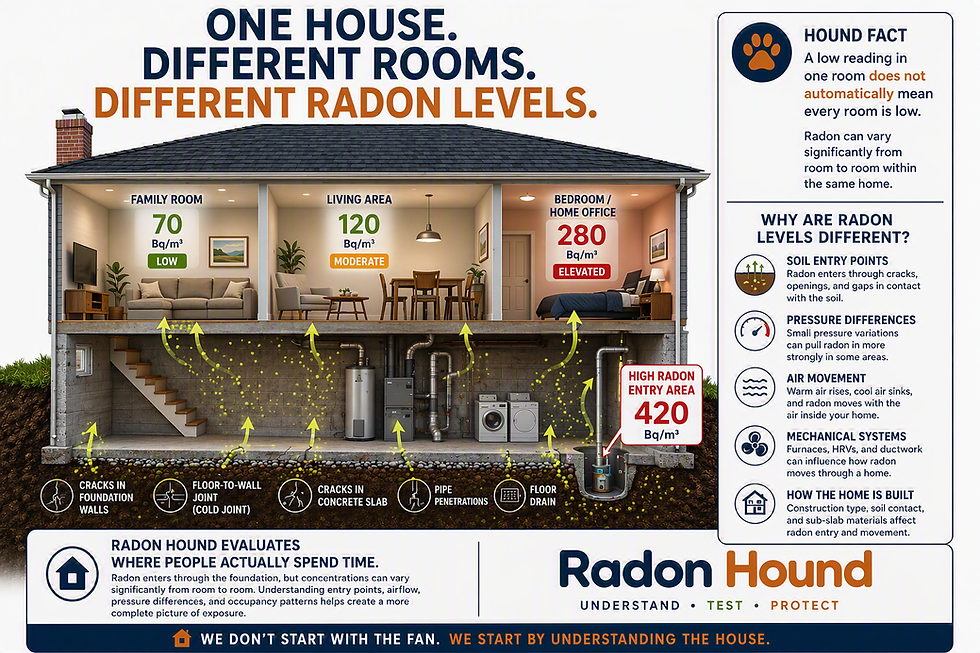
Guide to understanding radon test results for your home
Different ranges of Bq/m³ (becquerels per cubic metre) and pCi/L (picocuries per litre) represent varying levels of long-term health risk. However, the numbers on your report aren’t the whole story. Context is critical—how your home is structured and how your family uses the space play major roles in determining your actual exposure and the best path forward.
Understanding Radon Test Results and Next steps
Depending on your numbers, next steps might include monitoring, retesting, or mitigation. Radon Hound focuses on education ensuring you have the knowledge to make the best decision for your home.
Monitoring
If your levels are low but present, ongoing monitoring helps track fluctuations over different seasons and weather conditions.
Retesting
In cases where a short-term test shows elevated levels, a long-term retest (90 days+) is recommended for a more accurate yearly average.
Mitigation
If levels exceed 200 Bq/m³, mitigation systems can be installed to effectively reduce radon gas and protect your family's health.